🎨 Figure checks: colour and type
Status: reference.
The rules about how a figure is coloured and set: a border or a line too pale for its ground, words too pale for their fill, type smaller than the body, a colour from outside the house palette, and a card filled outside the house tint band. README.md explains how to read a report and how to record a deliberate exception.
Each rule below shows a faulty figure, the line figure check prints
for it, and the fixed figure. Both are real files in
examples/, and tests/test_figure_check_examples.py
compiles them, so the report lines on this page are what the check
prints today. The listings show the picture only; every file also
carries the house style block above it.
🖌️ The house palette
Every fix on this page names one of three roles. Each hue in the house
block has a pale tint to fill with, a darker Line shade to draw with,
and a darker still Text shade to write with. cgInk is the house
black, for labels and default strokes. cgPaper is the card ground,
one step off white.
| Hue | Fill (a tint, 6 to 12) | Line (border, edge, rule) | Text (coloured words) |
|---|---|---|---|
cgFlow |
cgFlow!7 |
cgFlowLine |
cgFlowText |
cgAccent |
cgAccent!11 |
cgAccentLine |
cgAccentText |
cgAlt |
cgAlt!9 |
cgAltLine |
cgAltText |
cgAux |
cgAux!10 |
cgAuxLine |
cgAuxText |
cgWarm |
cgWarm!12 |
cgWarmLine |
cgWarmText |
cgRose |
cgRose!10 |
cgRoseLine |
cgRoseText |
cgMute |
cgPaper |
cgMuteLine |
cgMuteText |
The fill column is what the house styles use (cgbox, cgkey,
cgalt, cgaux, cgwarm, cgrose, cgplain); any tint from 6 to 12
is in the band. The Line and Text shades are mixed towards cgInk
until they clear WCAG's 3:1 and 4.5:1 over white, cgPaper and every
tint the house block fills with. TIKZ-STYLE.md
gives the mixing shares and the reasons for each hue.
🧭 Rules on this page
k1-stroke
Catches. A box's border, or a connector, under WCAG's 3:1 against
its ground. The target is the node or the edge, a->b, and the
measurement names both colours and the ratio. The ground is the box's
own fill, else the innermost filled box that contains it, else white; a
connector's ground is the innermost filled box that holds both its
ends. Colours are what pgf drew with, so a style or #1 argument is
resolved. A translucent fill is read as opaque, a shadow is not a
ground, and a connector crossing a third zone is measured against its
ends' ground.
Why it matters. A border drawn in the same pale tint as its fill vanishes in print and on a projector, and a pale line looks like a gap.
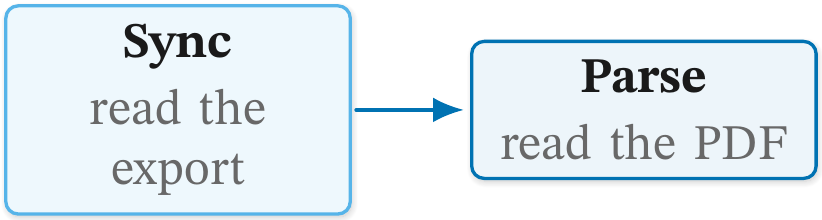
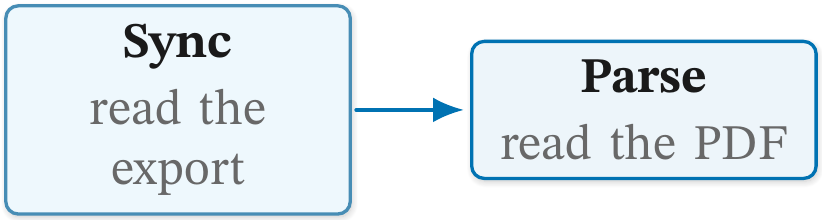
Faulty: the Sync card is drawn in cgAux, the hue it is filled with.
1 2 3 | |
1 | |
cgAux is a palette hue, so the same line does not also count as
colour-off-palette: the colour is the house's,
used for the wrong job.
Fixed: the override goes, and cgaux draws in cgAuxLine.
1 | |
| Faulty | Fixed |
|---|---|
 |
 |
Fix. Draw in the hue's Line shade (draw=cgAuxLine, not
draw=cgAux); a palette name fills, a Line name draws.
k2-text
Catches. A run of a node's text under 4.5:1 against the same ground
as k1-stroke, or under 3:1 where it is WCAG's large text (14pt bold,
or 18pt), measured from the typeset size. The target is the node, or
tag on a->b. It is read from the glyphs, so text=, \textcolor,
\color and a macro are all seen.
Why it matters. Grey or tinted words on a tinted box are the first thing lost when a page is printed, photocopied or read by someone with low vision.
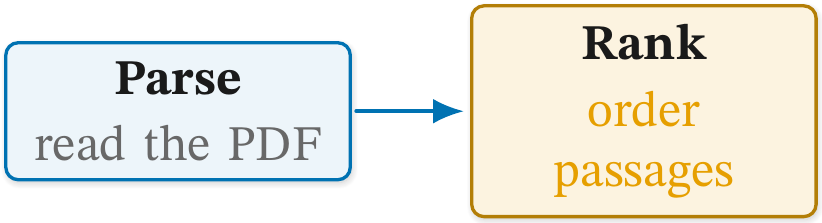
Faulty: the gloss of the warm Rank card is written in cgWarm, the
hue its fill is a tint of.
1 | |
1 | |
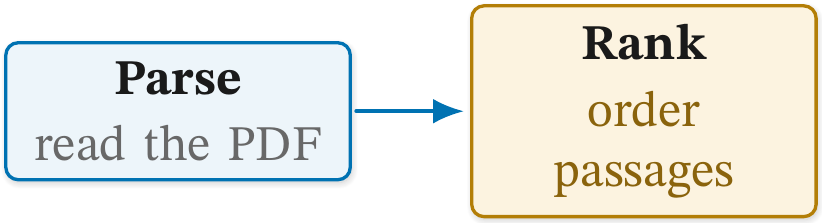
Fixed: the gloss is written in cgWarmText.
1 | |
| Faulty | Fixed |
|---|---|
 |
 |
Fix. Write in the hue's Text shade (text=cgAccentText,
\textcolor{cgAccentText}{...}), or cgInk.
type-below-floor
Catches. Text set smaller than the body, 12pt, which is the probe's
and the render's default. The target is the node, and the measurement
is the node's smallest text, 8.0pt, floor 12pt. It is read from the
glyphs, so \scriptsize, a size inherited from a group and a macro are
all seen. A math run is left alone, since a subscript sets at script
size on purpose, unless the node has nothing larger. Text inside a
subscript ($k_{\text{in}}$) is text and fires; write \mathrm there.
Why it matters. A figure whose labels run smaller than the paragraph beside it reads as an afterthought. Shrinking the type is never the fix for a box with too many words in it: that is the conciseness defect, and the fix is fewer words or a wider box.
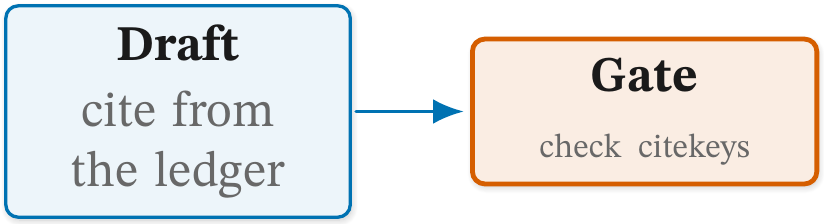
Faulty: the gate's gloss is shrunk to \scriptsize to keep it on one
line.
1 | |
1 | |
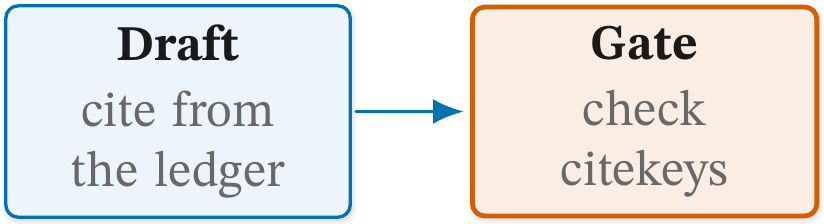
Fixed: the size command goes, and the gloss wraps.
1 | |
| Faulty | Fixed |
|---|---|
 |
 |
Fix. Set the text at the body size: delete \small, \scriptsize
and the like. If it does not fit, change the layout, never the type.
colour-off-palette
Catches. A border, fill, text run or line in a colour the figure's
house block does not define, nor a white tint of one: draw=blue,
fill=red!10, black (the house black is cgInk), or a hue darkened
by hand. A framed node with no draw= colour is reported as
border (current colour): a node half in the house style. The rule
decides by the colour pgf used, so a \foreach variable is read. A
line is named a->b, or by its first point. It is not measured without
the house block, and a path's fill outside a node is not read.
Why it matters. A figure that invents its own hues reads as imported from somewhere else, and its colours stop meaning what the palette says they mean.
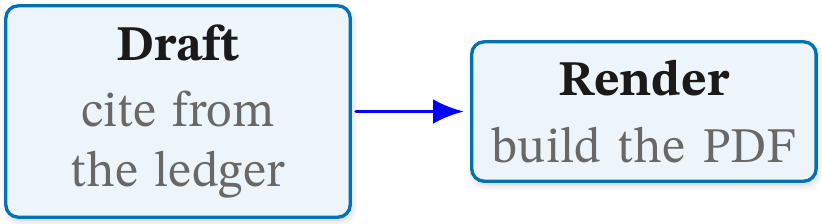
Faulty: the arrow from draft to render is drawn in LaTeX's blue.
1 2 3 | |
1 | |
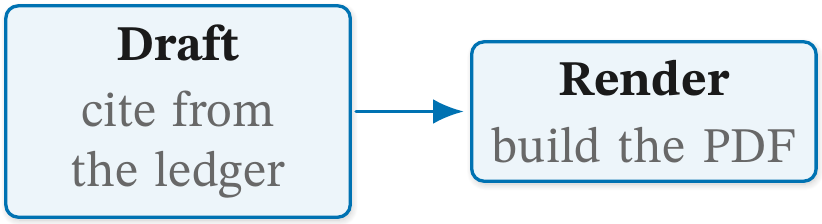
Fixed: the line is drawn in cgFlowLine, the colour cgedge already
gives it.
1 | |
| Faulty | Fixed |
|---|---|
 |
 |
Fix. Use the house colour for the job: a cg<Hue> tint to fill,
cg<Hue>Line to draw, cg<Hue>Text or cgInk to write. A
(current colour) border means a draw with no house style: use
cgbox.
tint-outside-band
Catches. A node with text, filled with a house hue mixed with white
outside 6 to 12, or filled solid: the hue itself, or its Line or
Text shade, which the label drowns in. The target is the node, and
the measurement is the fill, cgAlt!15, band 6 to 12. A round node
under 7mm (a step badge, a Text-shade disc) and a node with no text
(a timeline's tick) are left out.
Why it matters. The band is what keeps a card a wash that text
reads through. A darker tint pulls the eye to that card for no reason,
and the further it goes the closer its label comes to failing
k2-text.
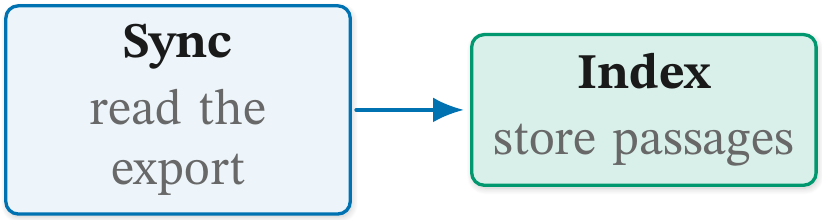
Faulty: the Index card is filled with cgAlt!15, past the band.
1 2 3 | |
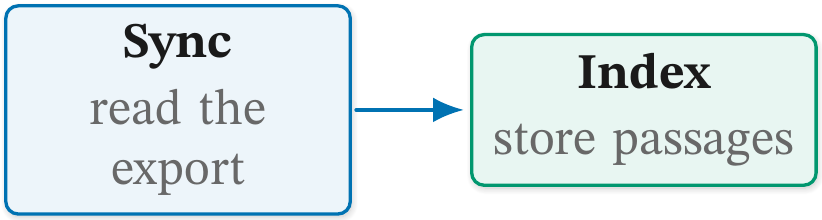
1 | |
Fixed: the override goes, and cgalt fills with cgAlt!9.
1 | |
| Faulty | Fixed |
|---|---|
 |
 |
Fix. Fill a card with a tint from 6 to 12 (fill=cgFlow!8), never
the hue or its shade.