🟦 Figure checks: nodes
Status: reference.
The rules about the boxes themselves: two that collide, one that says too much, an arrowhead left in the middle of a line, more than one accented node, and a house shape placed where nothing measures it. README.md explains how to read a report and how to record a deliberate exception.
Each rule below shows a faulty figure, the line figure check prints
for it, and the fixed figure. Both are real files in
examples/, and tests/test_figure_check_examples.py
compiles them, so the report lines on this page are what the check
prints today. The listings show the picture only; every file also
carries the house style block above it.
🧭 Rules on this page
node-overlap
Catches. Two nodes whose boxes intersect. The target is the pair,
a+b. A zone that contains its nodes is not an overlap, and neither is
a tag on a line (that is c6-tag-covered)
or a round node under 7mm, such as a step badge. Every node TikZ drew is
measured, including an unnamed one, which the report names by its
centre, (x,y) in mm.
Why it matters. The front box hides part of the one behind it, and the reader cannot tell whether the overlap means something.
Faulty: a negative gap puts index on top of parse.
1 2 3 4 5 | |
1 | |
Fixed: the same figure with an 8mm gap.
1 | |
| Faulty | Fixed |
|---|---|
 |
 |
Fix. More room between the pair (node distance, a gap). A pair
named (x,y) is a node the source does not name (a zone title, a note,
a pin, a child), at that point in mm. A label turned a quarter is
measured as set; text at any other angle is not.
node-text-overload
Catches. A node whose label runs past 15 words. The target is the node. The count is read from the source, with commands and braces stripped.
Why it matters. With a sentence in a box, the reader stops scanning the figure and starts reading it, and the text is set narrower than the prose around it.
Faulty: the whole indexing step is spelled out in the box.
1 2 3 4 | |
1 | |
Fixed: the box names the step, and the prose beside the figure explains it.
1 2 | |
| Faulty | Fixed |
|---|---|
 |
 |
Fix. Cut the label to 15 words or split the node.
stranded-arrowhead
Catches. A line drawn in pieces where an earlier piece ends in an
arrowhead at a bare coordinate and the next piece continues from that
point. The target is the point. The head sits in the middle of the
line, pointing at nothing. The check reads -> in a path's own
options.
Why it matters. The reader sees two arrows where the figure means one, and looks for the box the first one points at.
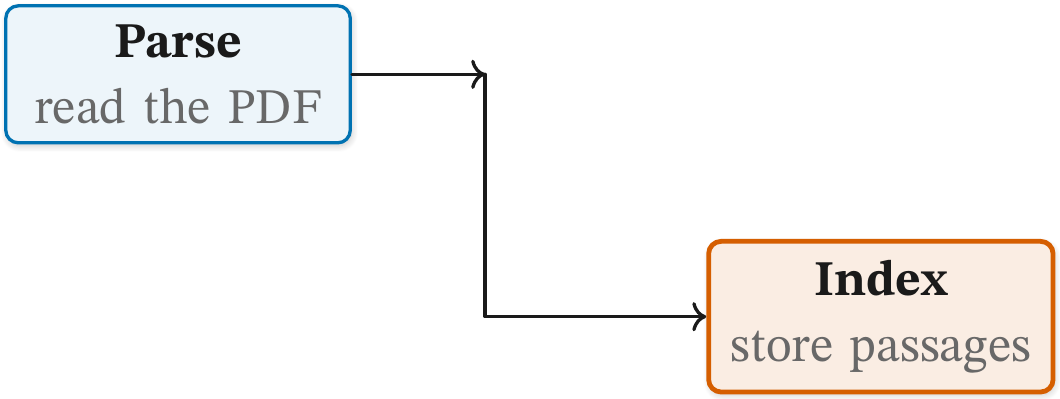
Faulty: the route is two \draw statements, and each carries a head.
1 2 3 4 | |
1 | |
Fixed: one \draw for the whole route, so the only head is at the end.
1 | |
| Faulty | Fixed |
|---|---|
 |
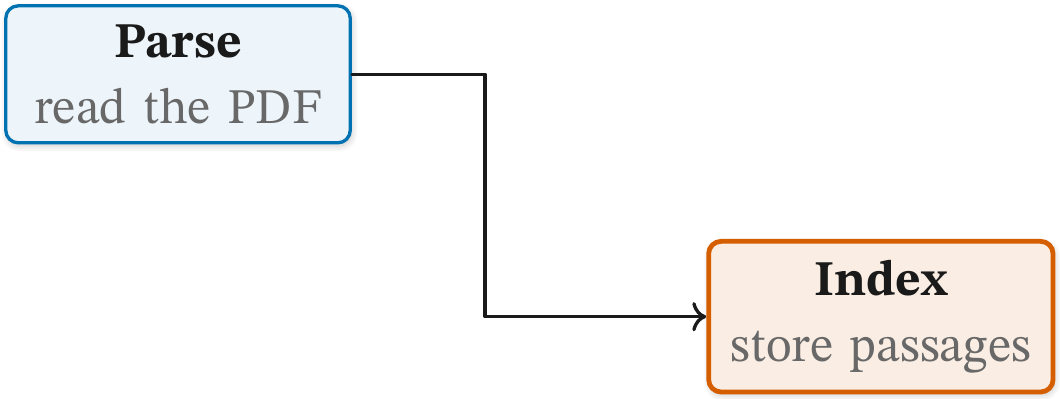 |
Fix. Put the -> on the last piece of the line only.
focal-count
Catches. More than one accented node: cgkey, cgkeystate on a
state, or cgfocus on a timeline tick. It is read from the source, so
an accent reached only through a style the figure defines itself is not
seen.
Why it matters. The accent says "this is what the figure is about". If two things are accented, neither is.
Faulty: both the first and the last stage are accented.
1 2 3 4 5 | |
1 | |
Fixed: parse goes back to a plain cgbox, and only the gate is
accented.
1 | |
| Faulty | Fixed |
|---|---|
 |
 |
Fix. Keep cgkey (cgkeystate on a state, cgfocus on a
timeline tick) on the one node the figure is about.
unnamed-pic
Catches. A house shape (\pic) that is not placed at a node the
figure declares with cgwell. The target is the pic and its place,
"cgstore at (6.6,0)".
Why it matters. No rule measures the paths inside a pic. A pic
placed at a bare coordinate can sit on top of a label and nothing
reports it. A pic in a named well is a node like any other: the overlap
rules see it, and a zone can fit it.
Faulty: the store icon is placed at a coordinate.
1 2 3 4 | |
1 | |
Fixed: the icon goes into a named well beside index.
1 2 | |
| Faulty | Fixed |
|---|---|
 |
 |
The two pictures look alike. The difference is that the check can now measure the icon, so the next time it drifts onto a label the report will say so.
Fix. Draw the pic into a named well: \node[cgwell, above=2.5mm of
a] (ia) {}; then \pic at (ia) {cgstore};.