🔗 Figure checks: connectors
Status: reference.
The rules about the lines between boxes: a slanted line on a grid, a tag on its own line, two lines that hide each other, a line landing off the middle of a side, a line through a box, a tag under a box, and an arrow that points at nothing. README.md explains how to read a report and how to record a deliberate exception.
Each rule below shows a faulty figure, the line figure check prints
for it, and the fixed figure. Both are real files in
examples/, and tests/test_figure_check_examples.py
compiles them, so the report lines on this page are what the check
prints today. The listings show the picture only; every file also
carries the house style block above it.
🧭 Rules on this page
📏 What a connector is
The connector rules measure the lines TikZ drew, not the source that
asked for them. A connector is a line whose two ends touch two
different nodes. A line that leaves no node, such as an axis, is not a
connector, and the report counts it under "lines not between two
nodes". An edge target is written a->b, from the node the line
leaves to the node it reaches.
🗺 Which rules apply to which layout
A rule that applies is measured on every figure of that layout.
Exempt means figure check skips the rule for a figure whose
% cg-layout: line names that layout, because the layout's grammar
breaks it on purpose. Rare means the rule is measured, but the
layout seldom gives it anything to find.
| Rule | Pipeline | Map | Layered stack | Control loop | Branching tree | Hub-and-spoke | Zoned spine | Comparison | State machine | Sequence | Timeline |
|---|---|---|---|---|---|---|---|---|---|---|---|
| c1-orthogonal | applies | rare | applies | applies | applies | exempt | applies | applies | exempt | applies | applies |
| c2-tag-clearance | applies | rare | applies | applies | applies | applies | applies | applies | applies | applies | rare |
| c3-coincident | applies | rare | applies | applies | applies | applies | applies | applies | applies | rare | rare |
| c4-attach | applies | rare | applies | applies | applies | exempt | applies | applies | exempt | exempt | applies |
| c5-transit | applies | rare | applies | applies | applies | applies | applies | applies | applies | exempt | applies |
| c6-tag-covered | applies | rare | applies | applies | applies | applies | applies | applies | applies | applies | rare |
| c7-dangling-tip | applies | rare | applies | applies | applies | applies | applies | applies | applies | applies | applies |
The layout ids are pipeline, map, layered-stack, control-loop,
branching-tree, hub-and-spoke-network, zoned-spine, comparison,
state-machine, sequence and timeline.
A map argues by where things sit, so its scaffold draws no line, and c1 to c7 seldom have anything to measure. A timeline's lines are the pieces of its axis, which carry no tag and never run side by side, so c2, c3 and c6 seldom fire on it; the rest hold every piece. A comparison's lines run inside each panel, never between them, and are held to every rule. A hub's spokes are diagonal and meet the centre at every angle, so it is exempt from c1 and c4. A state machine is exempt from the same two, because an automaton's transitions curve and loop back on their own state. A sequence is held to c1, since its messages are level, but not to c4 or c5: a message meets a lifeline wherever time puts it, and passes over the lifelines between its ends.
c1-orthogonal
Catches. A connector between nodes whose ends differ by more than
1mm in both x and y, drawn straight or bent instead of as an elbow
(-|, |-). The target is the edge, a->b. Not evaluated for the
hub-and-spoke-network and state-machine layouts; a tree is held to
it. A control loop's bend passes only between nodes that are level
with each other, which is how its scaffold draws it.
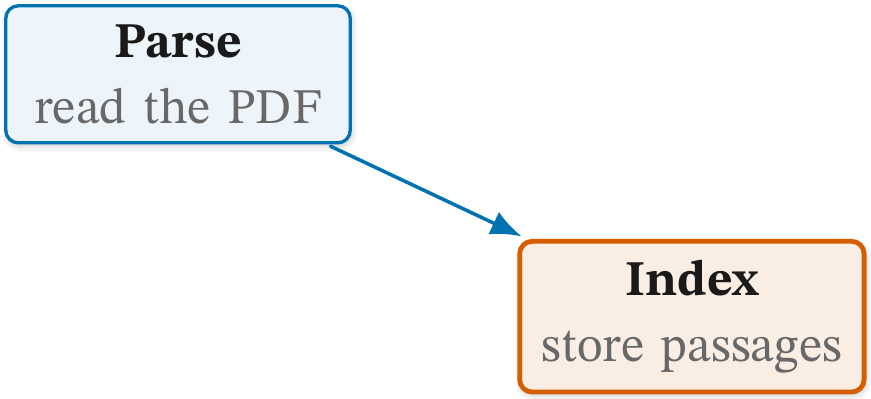
Why it matters. A slanted line between boxes on a grid reads as a different kind of relation, and two of them cross at angles the eye has to untangle.
Faulty: index sits below and to the right of parse, and the line
cuts across on a slant.
1 2 3 | |
1 | |
Fixed: the line leaves the side of parse and turns down into the top
of index.
1 | |
| Faulty | Fixed |
|---|---|
 |
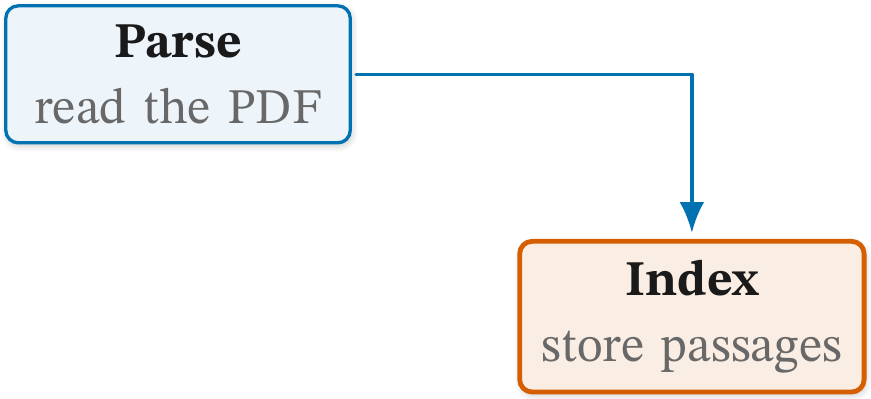 |
Fix. Route the edge as an elbow, -| or |-, or line the two
nodes up.
c2-tag-clearance
Catches. A tag whose text is under 1mm or over 3mm from its own
line's ink: the stroke's edge, half the line width off its centre, or an
arrowhead the tag sits beside (its text and the head share a stretch of
the line), measured from the outline pgf gives the head (#1113). The
target is the edge. It is measured from the text, not the node box,
which above and the rest put on the line; the house cgtag sets its
text 1.5mm off the centreline, about 1.35mm off the house stroke. A
sloped tag is not measured.
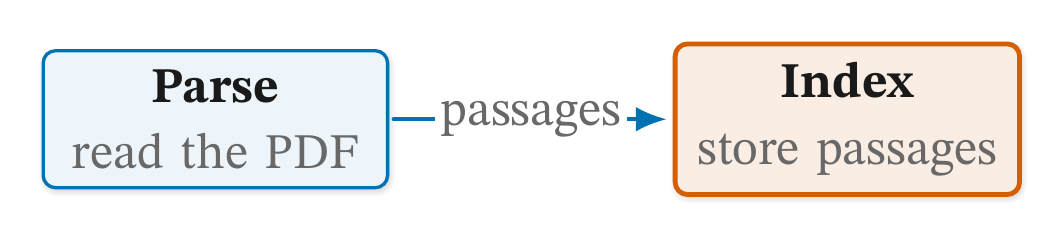
Why it matters. A tag on its line cuts the line where the eye is following it. A tag far from its line is read as belonging to the next one.
Faulty: the tag is filled white and centred on the line.
1 2 3 | |
1 | |
Fixed: a plain cgtag, which sets the word just above the line.
1 | |
| Faulty | Fixed |
|---|---|
 |
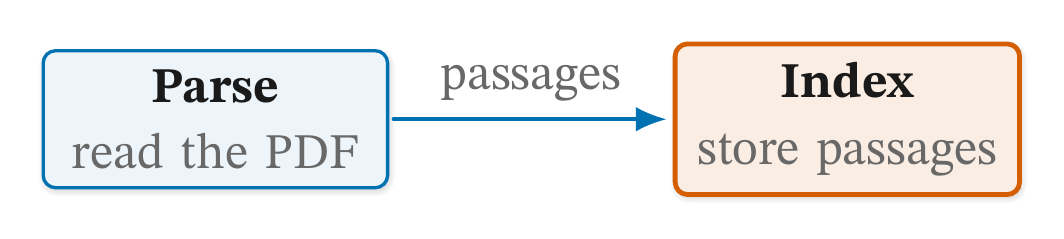 |
Fix. Use cgtag (unfilled, auto), which sits 1.5mm clear; never a
filled tag over its line, nor one beside an arrowhead: move it along with
pos=.
c3-coincident
Catches. Two connectors that run together for more than 2mm, so
one hides the other. The target is the pair, a->b+c->d. Two that
share an end point are a fork, and are not counted.
Why it matters. Where two lines coincide the reader sees one, and cannot tell where either goes.
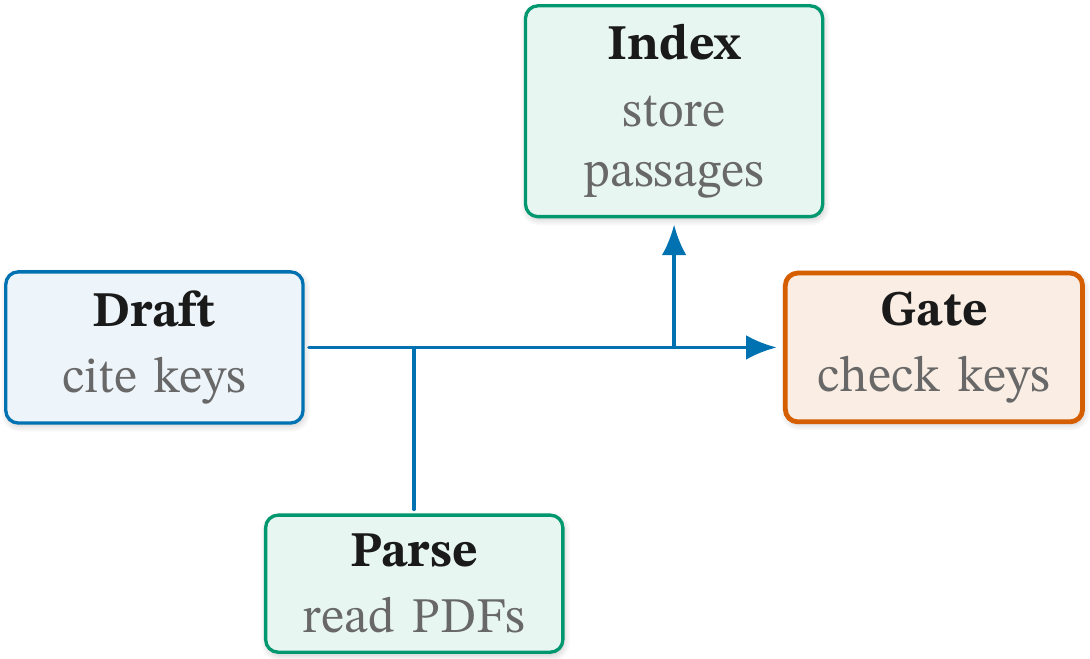
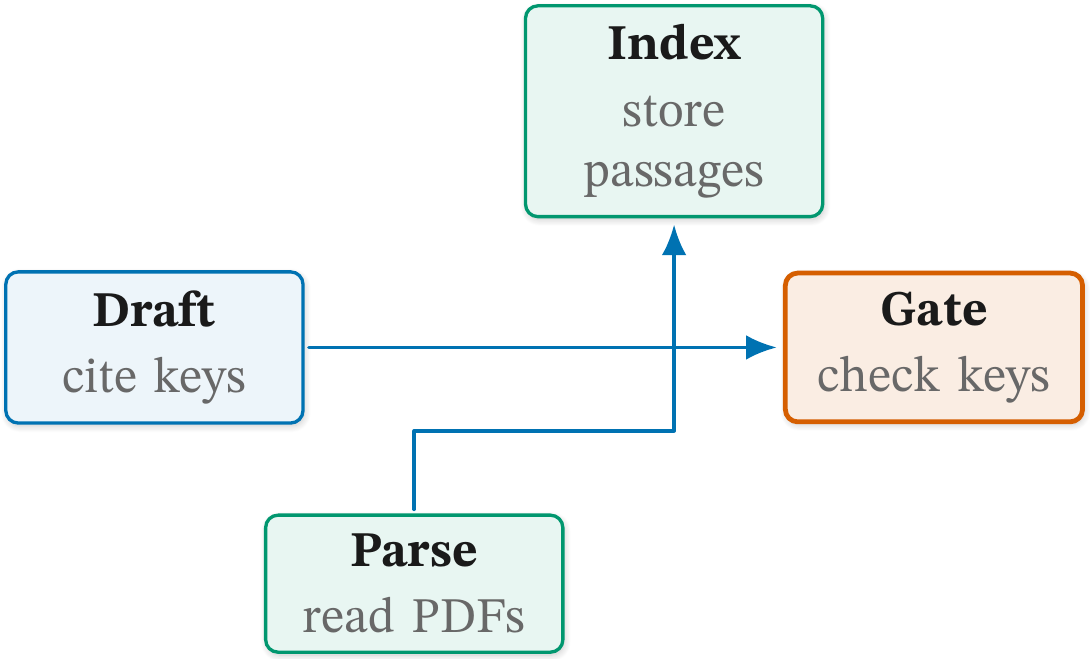
Faulty: the line from parse to index climbs to the row and runs
along the draft to gate line before it turns up.
1 2 3 4 5 6 | |
1 | |
Fixed: the second line turns below the row, in a lane of its own, and crosses the first instead of following it.
1 | |
| Faulty | Fixed |
|---|---|
 |
 |
Fix. Give each edge its own lane: attach at a different point, or offset one.
c4-attach
Catches. One end on a side over 1mm off its midpoint, or several
ends over 1mm off even spacing (L*k/(N+1)) or under 2mm apart. The
target is the side, a.north. It is measured only where a straight
connector meets the side square on, so an angled or bent end is left to
c1-orthogonal. Round nodes and zones are not measured. Not evaluated
for the layouts c1-orthogonal exempts, nor for sequence.
Why it matters. A line that lands near a corner looks as if it belongs to the next box, and lines bunched at one end of a side read as a single wider line.
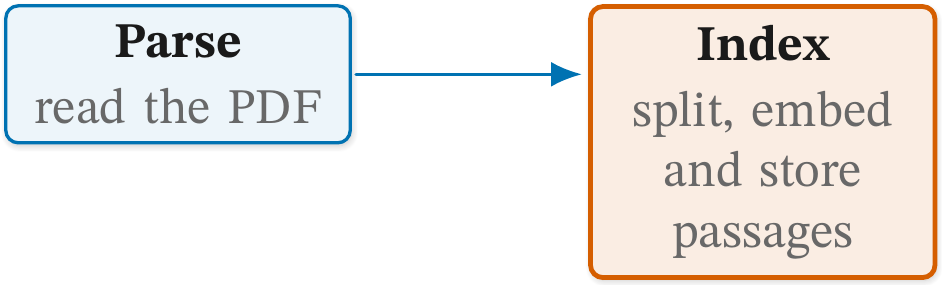
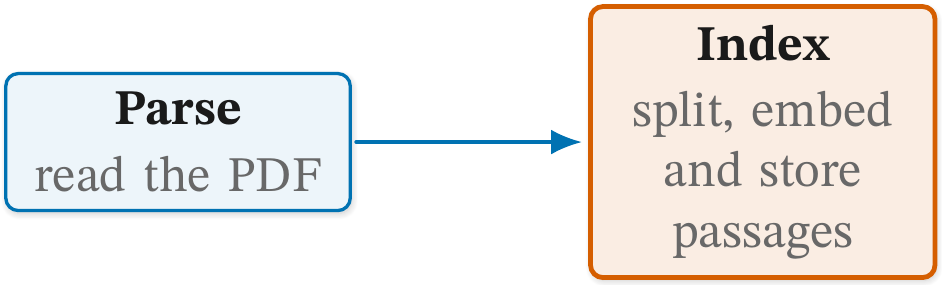
Faulty: index is taller than parse and their tops are aligned, so
a level line from the middle of parse meets index high on its
side.
1 2 3 4 | |
1 | |
Fixed: the two nodes share a centre line, and the edge runs between the nodes themselves.
1 2 3 | |
| Faulty | Fixed |
|---|---|
 |
 |
Fix. Attach a lone edge at the side's midpoint (a.east); spread
several evenly along the side, at least 2mm apart.
c5-transit
Catches. A connector that crosses a node that is neither of its
ends. The target is the edge, and the report names the node. A zone
containing an end, a marker under 2mm and an unframed group (an
undrawn fit) are not counted. Not evaluated for sequence, where a
message passes over the lifelines between its ends.
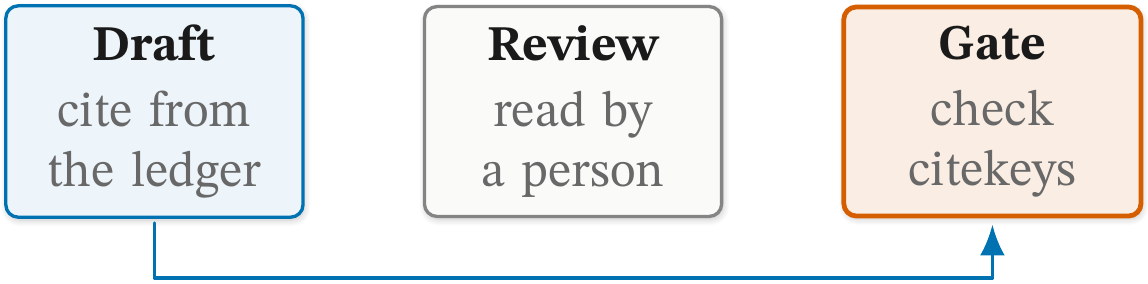
Why it matters. A line through a box reads as passing through that stage, which is a claim the figure did not mean to make.
Faulty: the line from draft to gate runs straight through
review.
1 2 3 4 | |
1 | |
Fixed: the line drops below the row and goes round.
1 | |
| Faulty | Fixed |
|---|---|
 |
 |
Fix. Re-route the edge around the node it crosses, or move the node.
c6-tag-covered
Catches. A tag that overlaps a node. The target is the edge whose
tag it is, a->b, and the report names the node. A zone containing
the tag and an unframed group are not counted.
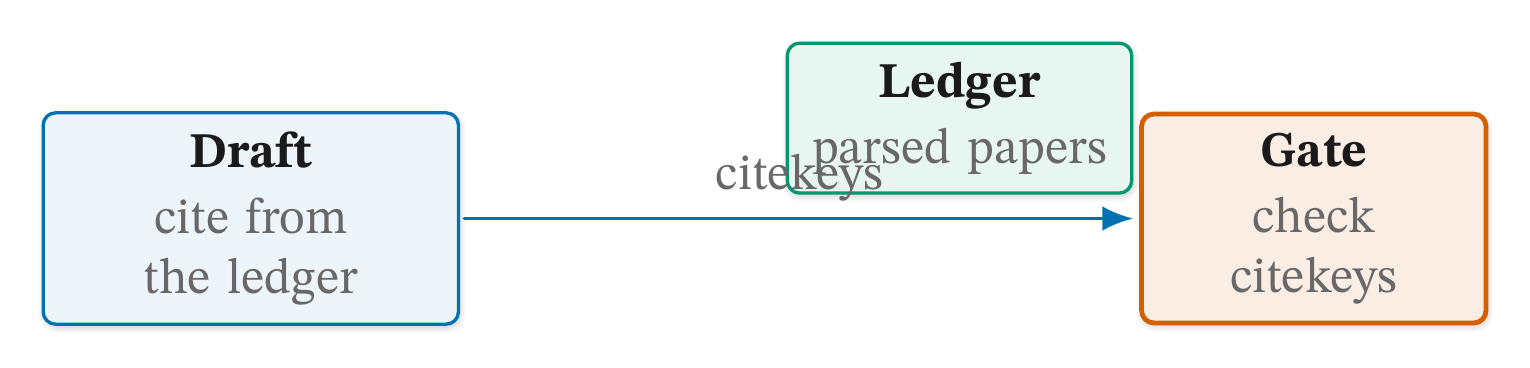
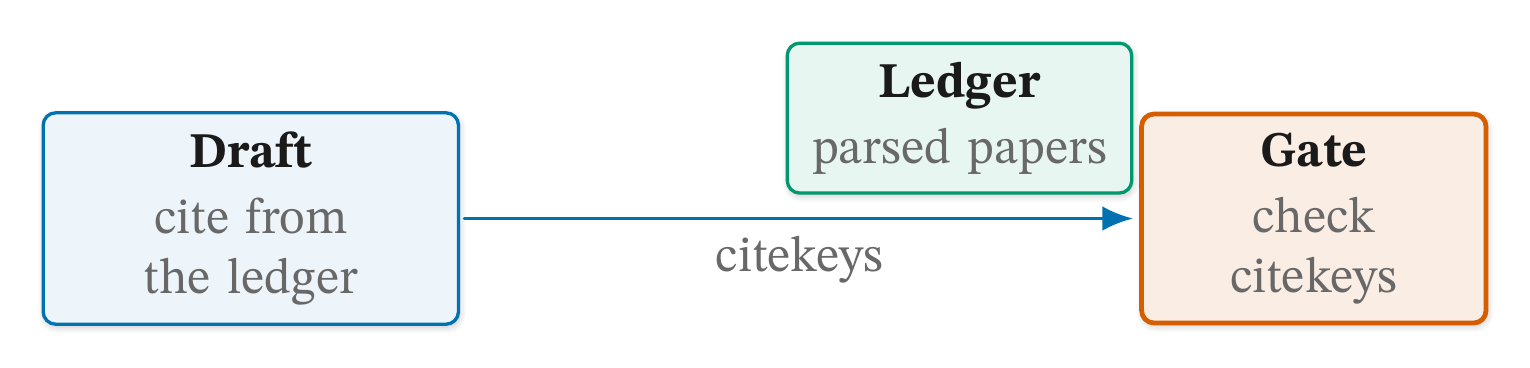
Why it matters. A tag under a box is half hidden, and a tag over a box reads as part of that box's label.
Faulty: the ledger card sits just above the line, and the tag, set
on the left of the direction of travel, runs into its bottom edge.
1 2 3 4 | |
1 | |
Fixed: swap sets the tag on the other side of the line, clear of the
card.
1 | |
| Faulty | Fixed |
|---|---|
 |
 |
Fix. Move the tag clear of the node it sits under.
c7-dangling-tip
Catches. An arrow leaving a node whose tip lands more than 1mm
from any node or other line. The target is the point, (x,y) in mm.
An axis or a two-headed dimension line, which leaves no node, is not
read.
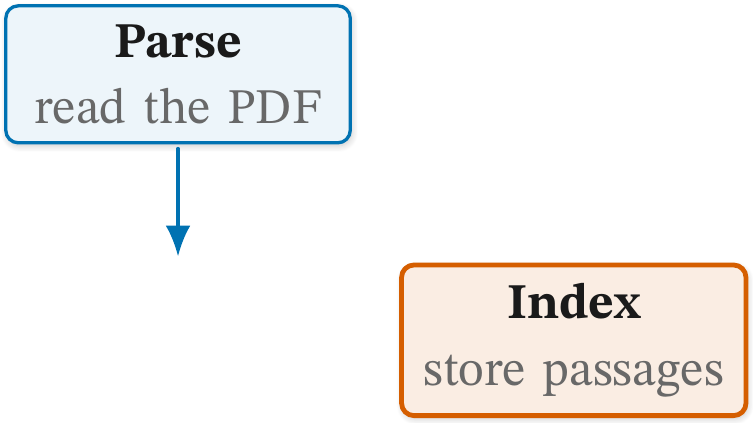
Why it matters. An arrow ending in empty space points at nothing,
and the reader looks for the box that is missing. It is most often a
computed end point, (a.south |- b.north), that lands beside the box
it was aimed at instead of on it.
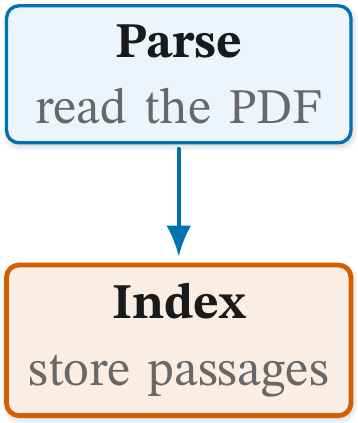
Faulty: the arrow ends at the height of index's top, straight below
parse, but index is off to the right.
1 2 3 | |
1 | |
Fixed: index goes directly under parse, and the arrow ends on the
node itself.
1 2 | |
| Faulty | Fixed |
|---|---|
 |
 |
Fix. End the arrow on the node it points to ((b), (b.north)),
not on a computed point beside it.